Casino
 Betting
 Games
Games 
 Payments
 Casino Bonus

Quiet Hours: Peak Traffic, Lower Casino Profit

- Quiet Hours: Peak Traffic, Lower Casino Profit

 Author: Saoirse Gallagher
 Updated: 20 January, 2026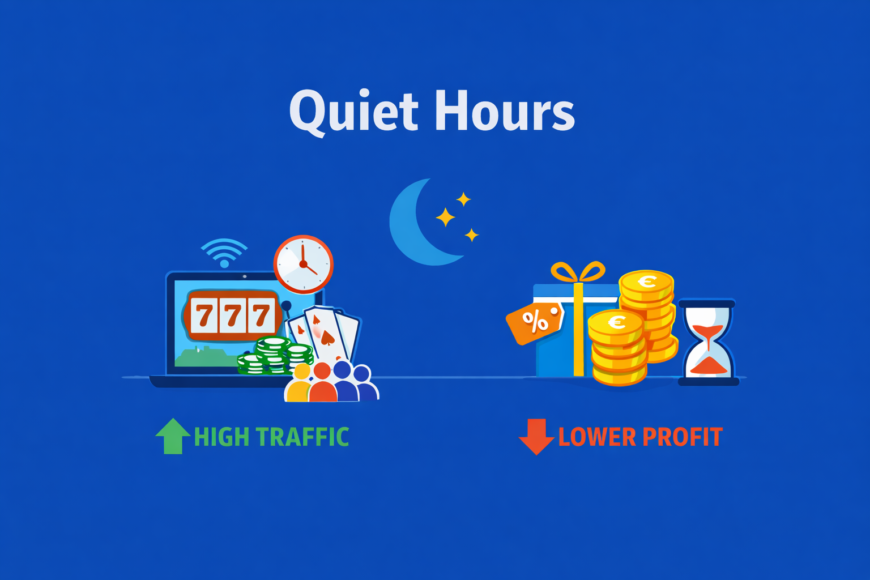
Online casino dashboards often reward one thing above all: activity. More logins, more concurrent sessions, more spins per minute. However, research into online casinos shows a recurring pattern where traffic rises but profitability softens once incentives, player intent, and operational costs are taken into account. These periods are known as “Quiet Hours.”
This post is written for the Irish market and connects to our press release on the topic. We explain what Quiet Hours look like in practice, why they happen, and how operators can respond. The key point is simple: volume and value are not the same. If they are treated as equal, it becomes easy to optimise for the wrong outcome. In short, the busiest hours can be the least rewarding when you measure net performance instead of surface-level activity.
What “Quiet Hours” Look Like in Practice
Quiet Hours are time windows when player activity is high, but profitability is softer once costs are included. They are usually defined by a repeatable set of signals:
| Signal during peak periods | What it typically indicates | Why profit can soften |
| High concurrent sessions and frequent logins | Strong traffic and repeat visits | Volume increases, but value per player may not rise at the same rate |
| Increased bonus activations and promo participation | Promotion-led engagement | Bonus costs scale with traffic and can compress net returns |
| Shorter average session duration | More casual, “quick play” behaviour | Lower time-on-platform often reduces net value per active player |
| Lower net value per active player (after costs) | Net performance weaker than surface metrics suggest | Incentives + product mix + operational load reduce profitability |
These patterns do not mean performance is weak. Instead, they often reflect a shift in player intent. Many sessions are more casual and more promotion-driven. As a result, volume rises while margins tighten. This is why traffic alone is not a reliable success metric. To understand true performance, operators need to look at net outcomes during peak hours, not just gross activity.
Why High Traffic Does Not Always Mean High Profit
It is tempting to equate peak concurrency with peak success. High traffic can indicate strong acquisition, effective retention, and a product that keeps people coming back. Yet profitability depends on what players do, what it costs to motivate that activity, and which products they choose while they are logged in.
Quiet Hours appear when the mix of player intent and commercial levers shifts. Players may arrive because a promotion is live, because they have a short break, or because they respond to a push notification. That can create bursts of logins and high game starts, but with lower stakes, shorter sessions, and faster churn. At the same time, operators may pay more in incentives and absorb higher costs in payments, customer support, and risk operations. The result is a busy platform with diluted net value per player.
Incentive Pressure: When Promotions Reduce Net Value
Promotions can drive fast growth, but they can also squeeze margins if they are pushed during already-busy hours without tight targeting. This is where incentive pressure shows up. As traffic rises, the cost of a casino bonus often rises with it. If an offer is easy to activate, participation spikes quickly. On the surface, that looks like a win. However, once you account for incentives, net returns can soften.
This effect is usually stronger when incentives are broad instead of segmented. A widely available cashback deal or mass free spins campaign can attract more casual sessions that are high in volume but low in value. Bonus rules can also shift behaviour. Players may place smaller bets, spread wagering across many rounds, or choose lower-risk gameplay to clear requirements. None of this is “bad.” Still, it means peak activity should be reviewed with a net-cost lens. Otherwise, the busiest hours can become the most expensive hours.
Casual Play and Short Sessions
Another driver is the type of engagement that dominates during busy periods. High activity can be fuelled by casual gameplay: shorter sessions, lower stakes, and quick drop-ins that inflate concurrency but lower average value per player. This is the difference between “many people doing a little” and “fewer people doing a lot.” Both create activity. Yet the commercial outcome can differ significantly.
Short sessions also complicate forecasting. When more players churn quickly, operators may see higher transaction frequency and a constant need to re-engage users through messaging, retention offers, or additional promotions. That raises costs while reducing time-on-platform. It can also shift preferences toward quick formats and low-commitment games. If that pattern dominates during peak windows, net revenue per active player can fall even while the platform looks highly engaged. Therefore, session quality matters as much as session count.
Product Mix: Busy Hours Can Skew to Lower Margins
Not all products deliver the same margin profile. Even within one category, title selection and player preferences can shift expected value. Product and game mix effects matter because peak windows can concentrate play in lower-margin content, reducing net performance even as activity rises.
This is why surface metrics can mislead. Two hours with identical login counts can produce very different outcomes depending on what players choose to play. A busy hour driven by short, low-stake sessions may look excellent in spins and engagement, yet yield lower value per player than a quieter hour with stronger-value behaviour. Mix effects can also be influenced by what the platform promotes on-site. If the lobby prioritises certain titles during traffic spikes, it can unintentionally steer play toward lower net yield. The takeaway is clear: “what is played” is a core profitability driver, not just “how many are playing.”
The Hidden Costs of Peak Load
Quiet Hours are not only shaped by incentives and player behaviour. They are also shaped by what it costs to run a platform when it is busiest. Peak load often brings higher churn, more transactions, and heavier customer support demand, which increases overhead. In practice, this can mean more payment processing events, more account and verification queries, and more responsible gambling interactions. It can also include extra monitoring when activity spikes across products like slots and live casino games.
These costs do not always show clearly on topline dashboards, but they can significantly reduce net profitability. Support volume typically rises with traffic. The same is true for payment issues, bonus questions, and login or withdrawal problems. Meanwhile, risk teams may face more alerts and exceptions as concurrency climbs. This matters because profitability is not just game revenue minus bonuses. It is operational reality too. If an operator optimises only for traffic, they can create avoidable load peaks. Those peaks can turn into Quiet Hours that look impressive but deliver less value.
What Quiet Hours Mean for the Industry in Ireland
For operators serving Irish players, Quiet Hours analysis is a practical planning tool, not just a headline. Identifying these windows helps align marketing activity with expected net value, refine incentive design, and allocate operational coverage more efficiently. It also supports a healthier internal conversation: are we optimising for activity, or for sustainable performance?
From a commercial standpoint, the implications are straightforward. Promotions should be scheduled and segmented with intent, not stacked onto peak traffic by default. Incentive mechanics should be built around net-value targets, not participation targets. Marketing spend should reflect expected outcomes after costs, not raw engagement. Operational teams should plan staffing, support coverage, and risk-control monitoring around load patterns. Quiet Hours do not need to be avoided. They need to be understood. When traffic is high but profitability softens, the correct response is smarter strategy, not more volume.
Closing Thoughts: Measure What Matters
Quiet Hours are a useful reminder that casino performance is multidimensional. Activity is the most visible metric, so it is easy to celebrate. However, net value is what shapes long-term results. When the busiest hours deliver weaker profitability, it is usually because incentives, player intent, product mix, and operational costs combine in predictable ways. If you only look at traffic, you may miss what is actually happening underneath.
The opportunity is to improve measurement and decision-making. Track net value per active player, not just concurrency. Separate growth metrics from profitability metrics. Then align promotions, product placement, and operational coverage to the moments that truly matter. High traffic can still be a positive signal. It just needs the right lens. This is the perspective Casinoble encourages with its “Quiet Hours” insight: not “busy equals better,” but “busy plus profitable equals sustainable.”

Saoirse Gallagher
ResearcherSaoirse was born and raised in Galway, where she developed a rebellious streak and a love for writing. She moved to Dublin to pursue a career in content writing and spends her free time playing poker and attending literary events.
Most Recent News
Get the latest information