Casino
 Betting
 Games
Games 
 Payments
 Casino Bonus

Europe Casino Trends 2026: Germany, Nordics, South

- Europe Casino Trends 2026: Germany, Nordics, South

 Author: Meri
 Updated: 8 May, 2026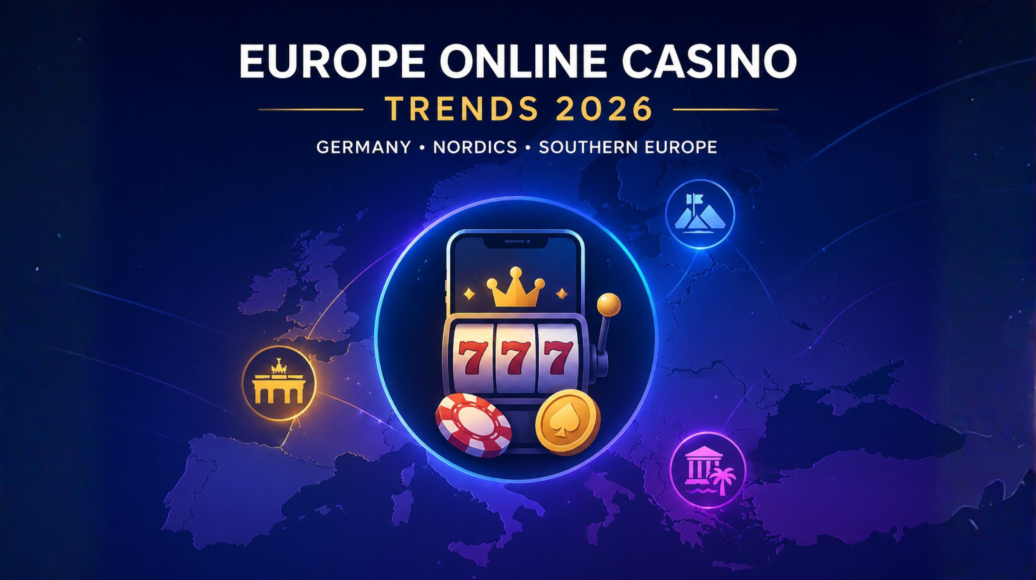
Europe’s online casino market in 2026 is shifting toward regulated, mobile-first, and trust-driven growth. At Casinoble, we observe that Germany, the Nordics, and Southern Europe are shaping this transition through different regulatory models and player behaviors.
Europe’s gambling market reached €123.4 billion in total revenue, with online channels contributing nearly €50 billion and around 39% of overall activity. This confirms a clear structural shift from land-based to digital play.
At Casinoble, we see that this growth is no longer driven by novelty. It is driven by habit. Players now treat online casinos as a primary option, supported by mobile access, fast payments, and stronger consumer protection frameworks.
Europe’s Online Casino Market Is Becoming More Structured
The main trend for 2026 is not uncontrolled growth. It is structured growth.
Online casino operators now compete in a market where regulation, mobile experience, payment speed, and trust matter more than game volume alone. Casino games are already the largest product category in Europe’s online gambling market, accounting for 45% of online gross gaming revenue in 2024, ahead of sports betting at 29%.
This matters because online casino games are always available. Slots, live dealer games, roulette, blackjack, and instant-win products fit short mobile sessions. Players do not need a match schedule. They can play during small gaps in the day.
The shift is also behavioral. Online gambling is no longer only an alternative to land-based casinos. For many users, it is the default access point. This is especially true in countries with strong digital payment systems, high smartphone use, and trusted licensing frameworks.
From an SEO and content perspective, this market should not be treated as one single European entity. Europe contains different regulatory models, player habits, and market maturity levels. A strong topical map should separate Germany, Sweden, Denmark, Finland, Italy, and Spain while linking them under the broader entity of European online casino regulation and growth. Semantic SEO depends on topical coverage, user intent alignment, and clear relationships between entities and attributes.
Mobile Play Will Define Online Casino Engagement in 2026
Mobile is the strongest engagement driver in Europe’s online casino market.
In 2024, mobile devices generated 58% of online gambling revenue in Europe. This share was higher than the prior year and supports the forecast that mobile will continue to dominate digital gambling behavior.
Mobile play changes the product. It creates shorter sessions. It increases repeat visits. It rewards fast loading, clear navigation, quick deposits, and simple withdrawals.
This means operators will likely focus on:
- Faster registration.
- Clearer responsible gambling tools.
- Easier account verification.
- Instant payment options.
- Mobile-first game lobbies.
- Better live dealer streaming.
- Fewer interface distractions.
The winning casino platform in 2026 will not be the platform with the largest library. It will be the platform that reduces friction while staying compliant.
This also affects affiliates and publishers. Content should answer mobile-led search intent. Users search for fast payments, licensed casinos, mobile slots, live casino apps, deposit limits, self-exclusion, and local legal status. Each section should work as a standalone answer because AI search and modern retrieval systems often extract content at passage level, not only page level.
Regional Market Shifts Across Germany, the Nordics, and Southern Europe
Europe’s online casino sector does not move at one speed. Germany is strict and cautious. The Nordics are digitally mature. Southern Europe is steady and regulation-led.
Germany: Compliance Is the Main Growth Filter
Germany remains one of Europe’s most important online casino markets because it combines a large population size with strict regulation.
The 2021 Interstate Treaty on Gambling created a regulated framework for online gambling. Germany uses strict licensing rules, deposit restrictions, and stake limits. Online slots have been associated with a €1 maximum stake limit, and the market has also faced debate around deposit limits and affordability rules.
This makes Germany different from more open online casino markets. Growth is possible, but it is controlled. Operators must compete through trust, compliance, player education, and product clarity.
For 2026, Germany’s key market shifts are:
- Licensed platforms will continue to gain trust.
- Unlicensed alternatives will remain a regulatory concern.
- Player protection tools will shape product design.
- Operators will test innovation within legal limits.
- Brand credibility will matter more than aggressive bonuses.
Germany is unlikely to deliver explosive online casino growth in 2026. But it may deliver more predictable growth. That matters for long-term operators, affiliates, and investors.
The Nordics: Digital Maturity and Player Protection Lead the Market
The Nordic region is the most digitally mature online casino zone in Europe.
Sweden and Denmark have strong online gambling ecosystems. Sweden’s gambling revenue reached SEK 27.85 billion in 2024, supported by growth in commercial online gaming. Denmark’s total gambling spend reached DKK 11.0 billion in 2024, and its online channelisation rate rose to 91.5%, meaning most online gambling activity occurred with licensed operators.
This is important. High regulation has not stopped digital adoption. In Denmark, licensed gambling channels have captured a very large share of the online market. That suggests users can accept strong controls when the licensed product is convenient and trusted.
Denmark also shows how player protection is becoming part of market maturity. The Danish self-exclusion scheme, ROFUS, had more than 55,000 registered self-excluded users by the end of 2024, according to industry reporting on Danish regulator data.
Finland is the major Nordic shift to watch. The Finnish government proposed ending Veikkaus’ monopoly in betting, online slots, and online casino games at the end of 2026, with the market moving toward licensing and competition.
For 2026, the Nordic trend is clear: regulated digital growth will continue, but consumer protection will remain central.
Southern Europe: Italy and Spain Grow Through Regulation, Not Speed
Southern Europe has a different growth pattern.
Italy and Spain have strong gambling cultures, established land-based traditions, and cautious regulatory systems. Online casino growth is steady, but operators face higher compliance costs and stricter advertising controls.
Italy has been restructuring its online gambling framework. Recent reporting notes higher license costs, tighter operational rules, and a smaller group of approved operators. Italy’s new online gambling license fee has been reported at €7 million, which favors established companies with strong compliance capacity.
Spain also follows a cautious model. Online gambling is legal under licensing, but operators face advertising limits, identity verification requirements, and safer gambling obligations. Spain’s 2024 market figures included €1.45 billion in federal private gaming revenue, which refers to online gambling at the federal level.
Southern Europe rewards localization. Players need familiar payment methods, trusted local language content, clear verification, and transparent bonus terms.
For 2026, Italy and Spain will likely reward operators that understand national rules. Fast expansion without regulatory fluency will be risky.
Detailed Comparison Table: Europe Online Casino Trends by Region
| Region | 2026 Market Direction | Main Growth Driver | Main Constraint | Player Behavior | Operator Priority |
| Germany | Slow but more predictable regulated growth | Licensed migration and trust-building | Deposit limits, stake limits, advertising rules | Players seek legal clarity and safe platforms | Compliance-first product design |
| Sweden | Mature digital gambling market | High digital adoption and commercial online gaming | Channelisation and responsible gambling pressure | Users expect smooth mobile UX and trusted brands | Retention, safety tools, and brand trust |
| Denmark | Highly channelised licensed market | Strong regulatory trust and online casino growth | Strict oversight and self-exclusion rules | Players use licensed platforms at high rates | Licensed market strength and safer gambling |
| Finland | Major transition market | Shift from monopoly to licensing | Reform timing and new rules | Players may move from monopoly/offshore options to licensed brands | Market entry preparation and compliance |
| Italy | Large but selective market | Strong casino demand and licensing reform | High license costs and tighter rules | Players value trusted, localized platforms | Scale, compliance, and local market knowledge |
| Spain | Stable regulated growth | Online casino, identity controls, and safer gambling systems | Advertising limits and verification rules | Players accept strict checks when platforms are trusted | KYC, responsible gambling, and retention |
This table shows the core point: Europe has one digital direction, but several regional models.
Germany is about constraint. The Nordics are about maturity. Southern Europe is about regulated resilience.
What 2026 Will Reward Across Europe
The online casino brands that win in Europe in 2026 will not rely only on bonuses.
They will win through execution.
The main success factors are:
- Regulatory compliance
Licensing, player checks, deposit controls, and responsible gambling tools will define market access. - Mobile performance
Fast mobile pages, clear navigation, and low-friction payments will shape user retention. - Localized content
Germany, Sweden, Denmark, Finland, Italy, and Spain need different messages, examples, payment terms, and legal explanations. - Trust signals
Users need clear ownership, licensing information, support options, and safer gambling links. Google’s Search Quality guidelines also emphasize page purpose, main content quality, reputation, and trust when evaluating helpful pages. - Player protection
Self-exclusion, affordability checks, reality checks, and spending controls will become core product features. - Clear information architecture
Pages should separate online casino laws, market trends, payment methods, bonuses, mobile play, and responsible gambling. This improves topical coverage and avoids mixed intent.
For SEO, the best content strategy is a semantic content network. A hub page can target “Europe online casino trends 2026.” Cluster pages can target “Germany online casino regulation,” “Nordic online gambling markets,” “Italy online casino licensing,” and “Spain gambling advertising rules.” This improves topical authority by connecting entities, attributes, and user intent.
Conclusion
Europe’s online casino market in 2026 is defined by structure, not speculation.
Germany continues to evolve through strict compliance. The Nordics lead with digital maturity and player protection. Southern Europe grows steadily through regulation and localization. Together, these regions show that Europe does not follow a single model, but a shared digital direction.
At Casinoble, we recognize that success in this market depends on execution. Operators must align with local regulations, optimize for mobile use, and build trust through transparency and responsible gaming tools.
In 2026, Europe’s online casino sector will reward disciplined growth, regional understanding, and player-first strategies rather than rapid expansion.

Meri
Most Recent News
Get the latest information